
ASTROVITAL AI: VITALX CORE V1
Project Name
Category
Status
Repository
ASTROVITAL AI
Overview
ASTROVITAL AI is a personal aerospace software initiative focused on developing intelligent clinical decision-support systems for human spaceflight and deep-space exploration.
The first implementation, ASTROVITAL AI : VITALX CORE V1, is an open-source implementation and architectural exploration inspired by a 2012 theoretical research paper on deep-space human health.
The project explores how critical medical decision support can be brought closer to astronauts when communication delays make continuous Earth-based medical assistance impractical.
Core Concept
Deep-space missions introduce a fundamental challenge: increasing distance from Earth creates communication latency.
ASTROVITAL AI explores an onboard intelligence layer capable of processing available astronaut health information and providing structured clinical decision support.
Astronaut ↓ Health / Physiological Data ↓ Data Processing ↓ Intelligent Analysis ↓ Clinical Decision Support ↓ Crew Decision
Personal Aerospace Initiative
ASTROVITAL AI is the central aerospace software initiative of my personal engineering work. Its long-term direction combines:
- Human Health in Deep Space
- GNC (Guidance, Navigation, and Control)
- Remote Sensing
- Satellite Data Analysis
- Artificial Intelligence
- Automation
VITALX CORE V1
V1 establishes the initial foundation of the ASTROVITAL AI architecture. The primary focus is autonomous clinical decision support for astronauts operating in environments where immediate Earth-based medical assistance may not be available.
Future Versions
The ASTROVITAL AI roadmap includes:
- V1.5: Expansion and deeper aerospace integration
- V2: Advanced integrated aerospace intelligence
Core Question
How much critical medical decision support can be moved from Earth into the spacecraft itself?
Deep-Space Constraints
ASTROVITAL AI — Problem Definition
The Core Problem
Human spaceflight becomes increasingly complex as missions move farther away from Earth. One of the most critical challenges is medical autonomy.
On Earth, serious medical events can be supported by:
- Physicians
- Specialists
- Hospitals
- Diagnostic infrastructure
- Real-time communication
- Emergency response systems
Deep-space crews operate under significantly different constraints.
Communication Delay
As the distance between Earth and a spacecraft increases, communication latency becomes an important operational constraint.
A conventional medical-support sequence may look like:
Medical Emergency ↓ Astronaut contacts Earth ↓ Data transmitted to Earth ↓ Medical experts analyse situation ↓ Recommendation transmitted back ↓ Astronaut receives guidance
For time-critical situations, this dependence on Earth-based support can become problematic.
The Autonomy Requirement
Deep-space missions require increasing levels of onboard autonomy. A spacecraft should ideally be capable of supporting its crew when:
- Communication with Earth is delayed.
- Immediate ground support is unavailable.
- Multiple physiological variables must be interpreted.
- Medical expertise is not physically present.
- Rapid decision support is required.
Beyond Simple Prediction
A medical prediction model alone is not equivalent to a Clinical Decision Support System. The broader problem involves:
Physiological Data ↓ Data Validation ↓ Feature Interpretation ↓ Medical State Assessment ↓ Risk Identification ↓ Clinical Decision Support ↓ Action Assistance
Each stage introduces its own engineering and scientific challenges.
Central Research Question
Can intelligent onboard clinical decision support reduce dependence on delayed Earth-based medical intervention during deep-space missions?
Engineering Objective
The objective is to develop a software architecture capable of transforming available astronaut health information into useful, structured decision-support intelligence.
Long-Term Challenge
The ultimate challenge is not simply detecting a medical condition. It is developing intelligent support capable of operating under:
- Communication delay
- Limited resources
- Data uncertainty
- Mission constraints
- Extreme environments
This is the core problem ASTROVITAL AI is designed to investigate.
ASTROVITAL AI — Proposed Solution
Solution Overview
ASTROVITAL AI explores an onboard intelligent Clinical Decision Support System designed for deep-space human missions.
Instead of depending entirely on Earth-based medical intervention, the system introduces a layer of medical intelligence directly within the spacecraft environment.
Core Architecture
The fundamental concept is:
Astronaut ↓ Health / Physiological Data ↓ Data Processing ↓ AI / Intelligence Engine ↓ Clinical Assessment ↓ Decision Support ↓ Astronaut / Crew
Onboard Intelligence
The central principle is to move critical decision-support capability closer to the astronaut.
Traditional Model: Astronaut → Earth → Medical Expert → Earth → Astronaut
ASTROVITAL AI Model: Astronaut → Onboard Clinical Intelligence → Immediate Decision Support
Earth-based specialists can remain an additional layer of support whenever communication allows.
Human-in-the-Loop
ASTROVITAL AI is designed as a decision-support system rather than a replacement for human medical judgement. The system prioritizes:
- Explainability
- Structured recommendations
- Confidence awareness
- Data-quality awareness
- Human oversight
- Safety constraints
Multi-Level Intelligence
A future implementation can operate through multiple levels:
- Level 1 — Monitoring: Continuously observe available physiological information.
- Level 2 — Detection: Identify potentially abnormal patterns.
- Level 3 — Assessment: Estimate possible medical states and associated risks.
- Level 4 — Decision Support: Provide structured clinical information and potential response pathways.
- Level 5 — Human Confirmation: Allow the astronaut or medical officer to review and act on recommendations.
- Level 6 — Autonomous Support: Future versions may explore carefully constrained autonomous responses for predefined mission-critical scenarios.
Long-Term Multidomain Integration
ASTROVITAL AI is intended to grow beyond medical intelligence alone. Its long-term architecture explores the combination of:
Human Health + GNC + Remote Sensing + Satellite Data Analysis + AI + Automation
This creates the foundation for a broader aerospace intelligence platform.
Intended Outcome
The immediate goal of V1 is to establish the foundation for autonomous deep-space clinical decision support. Future versions will progressively investigate deeper integration between medical intelligence, spacecraft systems, remote sensing, GNC, AI, and automation.
Core Principle
Bring critical intelligence closer to the astronaut when Earth cannot respond immediately.
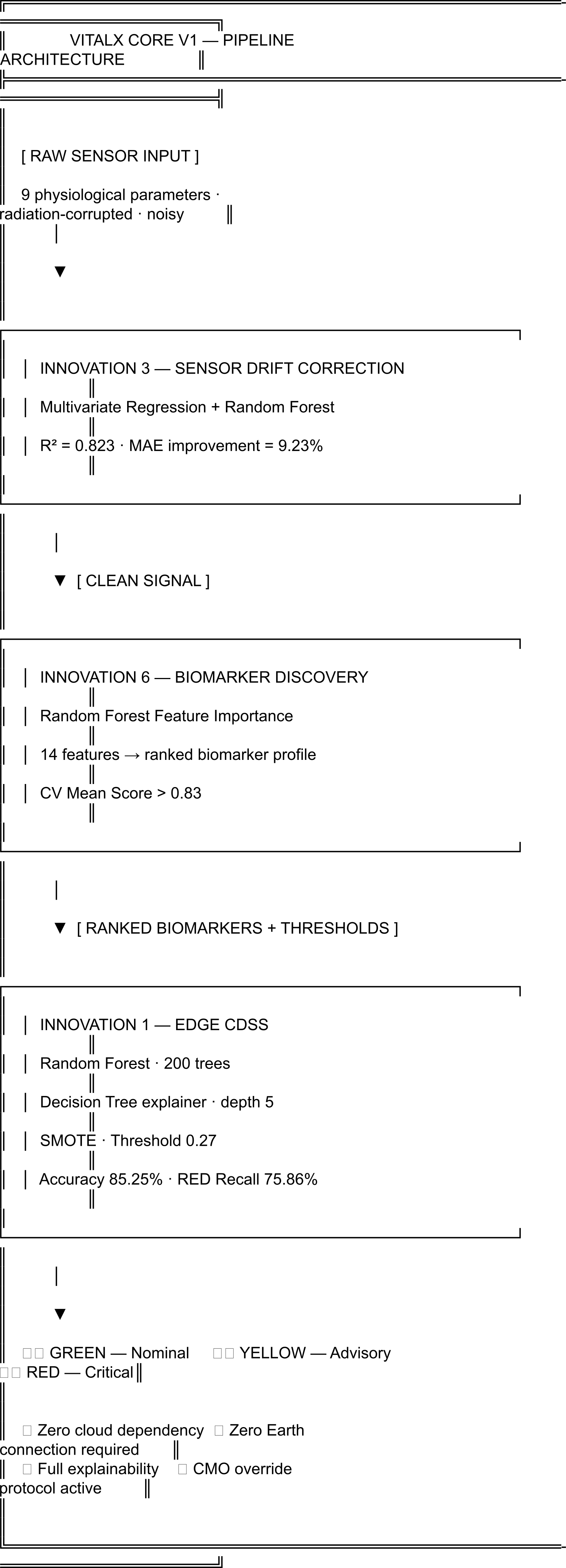
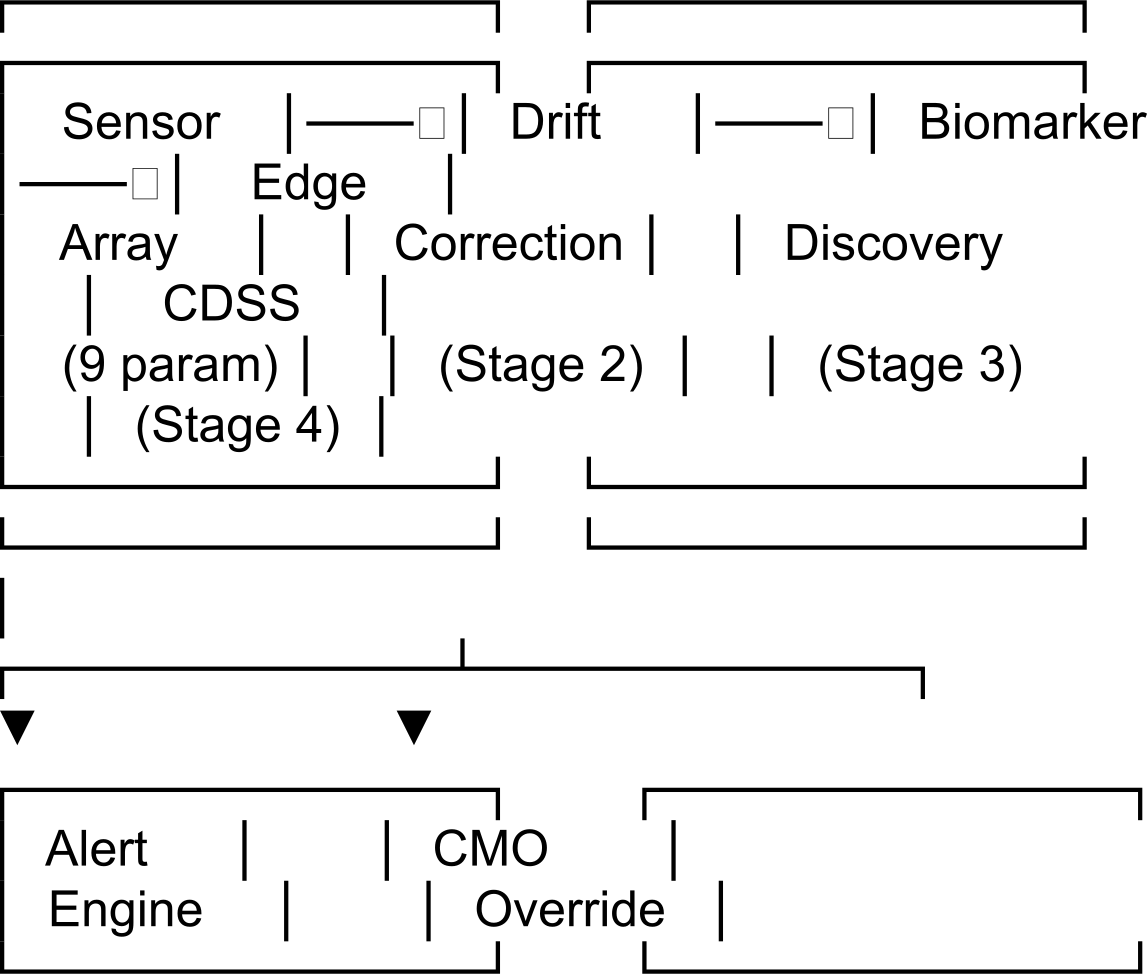

ASTROVITAL AI — System Architecture
Architectural Objective
ASTROVITAL AI is designed around the concept of an onboard Clinical Decision Support System for human spaceflight and deep-space missions.
The architecture separates data acquisition, processing, intelligent analysis, decision support, and human interaction into modular layers.
High-Level Architecture
+-----------------------------------------+ | ASTRONAUT / CREW | +--------------------+--------------------+ | v +-----------------------------------------+ | PHYSIOLOGICAL DATA LAYER | | | | Vital Signs / Medical Parameters | | Health Observations / User Inputs | +--------------------+--------------------+ | v +-----------------------------------------+ | DATA PROCESSING LAYER | | | | Validation / Cleaning / Normalization | | Feature Preparation / Data Quality | +--------------------+--------------------+ | v +-----------------------------------------+ | INTELLIGENCE LAYER | | | | Pattern Analysis / Prediction | | Risk Assessment / Decision Logic | +--------------------+--------------------+ | v +-----------------------------------------+ | CLINICAL DECISION SUPPORT | | | | Assessment / Alerts / Recommendations | +--------------------+--------------------+ | v +-----------------------------------------+ | CREW INTERFACE | | | | Results / Alerts / Decision Assistance | +-----------------------------------------+
Architectural Layers
1. Crew Layer
The crew is the primary human interaction layer. The system should communicate information clearly and efficiently, especially during stressful or time-critical situations.
2. Data Acquisition Layer
This layer represents the collection of available astronaut health information. Potential inputs may include:
- Vital signs
- Physiological measurements
- Medical observations
- Historical health information
- Mission context
3. Data Processing Layer
Raw information must be prepared before intelligent analysis. Potential processing operations include:
- Data validation
- Normalization
- Noise handling
- Missing-data handling
- Feature preparation
- Temporal analysis
4. Intelligence Layer
The intelligence layer analyses processed information. Potential functions include:
- Pattern recognition
- Classification
- Prediction
- Risk estimation
- Anomaly detection
- Medical-state assessment
5. Clinical Decision Support Layer
This layer transforms analytical results into structured decision-support information. The objective is not simply to produce a prediction. The system should help communicate:
- What may be happening
- How significant the situation may be
- What information supports the assessment
- What actions may require consideration
6. Human Interface Layer
The final information must be presented in a form that astronauts can understand quickly. The interface should prioritize:
- Clarity
- Speed
- Low cognitive load
- Alert prioritization
- Explainability
Communication Architecture
A central design principle is that the onboard system should remain useful even when communication with Earth is delayed.
                EARTH
                  │
         Delayed Communication
                  │
                  ▼
         ┌─────────────────┐
         │   SPACECRAFT    │
         │                 │
         │  ASTROVITAL AI  │
         │                 │
         └────────┬────────┘
                  │
                  ▼
                CREW
Earth-based medical expertise remains important, but ASTROVITAL AI provides an additional onboard intelligence layer.
Future System Integration
Future versions may explore integration with additional mission information:
Crew Health + Spacecraft State + Mission Context + Environmental Data + GNC Data + Remote Sensing │ ▼ ASTROVITAL AI │ ▼ Mission Intelligence
Architecture Principle
Local intelligence should remain available even when Earth-based support is delayed.
ASTROVITAL AI — Technology Stack
Technology Philosophy
ASTROVITAL AI is a software-centric aerospace research and engineering project. Its technology direction is built around:
- Scientific computing
- Artificial intelligence
- Data processing
- Clinical decision support
- Automation
- Aerospace software
The exact implementation stack may evolve across different versions.
Programming Languages
Python
Python is a primary language for:
- Data processing
- Machine learning
- Scientific computing
- Prototyping
- Automation
- Model development
C++
C++ is relevant to the broader aerospace software ecosystem for:
- Performance-critical computation
- Embedded systems
- Real-time logic
- Aerospace applications
Artificial Intelligence
AI/ML capabilities explored by the project include:
- Machine Learning
- Neural Networks
- Predictive Analytics
- Classification
- Pattern Recognition
- Anomaly Detection
- Decision Support
AI is treated as one component of a larger systems architecture rather than as the complete solution.
Data Processing
The system requires structured processing of physiological and medical information. Core concepts include:
- Data validation
- Data normalization
- Feature engineering
- Temporal analysis
- Data-quality assessment
- Model input preparation
Automation
Automation is a core part of the long-term ASTROVITAL AI vision. The objective is to reduce unnecessary manual processing and transform available information into structured decision-support intelligence as efficiently as possible.
Scientific Computing
Scientific computing principles support future development involving:
- Mathematical models
- Statistical methods
- Physical constraints
- Simulation
- Machine learning
Aerospace Integration
GNC
Guidance, Navigation, and Control data may provide mission and spacecraft-state information to future versions.
Remote Sensing
Remote sensing may provide environmental and planetary information for broader mission intelligence.
Satellite Data Analysis
Satellite data-processing pipelines may become part of future multidomain ASTROVITAL AI architectures.
Software Engineering
The project can use a modular architecture consisting of:
- Data pipelines
- Processing modules
- AI/ML modules
- Decision-support modules
- APIs
- Automation services
- Containerized components
Development Tools
The broader development ecosystem includes:
- Python
- C++
- Git
- Linux
- VS Code
- Docker
- Machine Learning frameworks
- Scientific computing libraries
Long-Term Technology Direction
The long-term ASTROVITAL AI technology architecture explores:
Human Health + AI/ML + Automation + GNC + Remote Sensing + Satellite Data + Aerospace Computing
The objective is to progressively integrate these capabilities into a unified aerospace intelligence architecture.
ASTROVITAL AI — Achievements
VITALX CORE V1
Status
Completed / Active Open-Source
ASTROVITAL AI : VITALX CORE V1 represents the first implemented generation of the ASTROVITAL AI initiative. It establishes the initial software and architectural foundation for autonomous clinical decision support in deep-space environments.
Research-to-Implementation
One of the central achievements of the project is the transition from a theoretical research concept toward a practical software implementation.
The project was developed through the study and implementation-oriented exploration of a 2012 theoretical research paper concerning deep-space human health.
Open-Source Development
ASTROVITAL AI V1 has been made available as an open-source project.
- Repository: https://github.com/GOURGOPAL618
The open-source approach allows the implementation and architecture to be inspected, studied, and developed further.
Aerospace Software Development
The project represents an independent effort to apply software engineering and artificial intelligence to a problem specific to human spaceflight.
The primary focus is autonomous clinical decision support under deep-space communication constraints.
Multidisciplinary Engineering
ASTROVITAL AI combines several technical and scientific domains:
- Bio-Astronautics
- Human Spaceflight
- Clinical Decision Support
- Artificial Intelligence
- Machine Learning
- Automation
- Software Engineering
Its future roadmap extends toward:
- GNC
- Remote Sensing
- Satellite Data Analysis
Systems Engineering Approach
The project goes beyond a standalone prediction model. It explores how multiple software layers can work together:
Data → Processing → Intelligence → Assessment → Decision Support → Human Interaction
This systems-oriented approach forms the foundation of the ASTROVITAL AI architecture.
Personal Engineering Milestone
ASTROVITAL AI became the first flagship aerospace software project in my independent engineering journey. It marked the transition from being interested in space to actively building software systems for space-related problems.
Continuing Development
VITALX CORE V1 is the foundation rather than the final destination. Future generations are planned as:
- ASTROVITAL AI V1.5
- ASTROVITAL AI V2
Status
Status
Status
Objective
ASTROVITAL AI — Development Roadmap
Roadmap Philosophy
ASTROVITAL AI is planned as a long-term aerospace software initiative. The project will evolve progressively from the current V1 foundation toward increasingly integrated autonomous aerospace intelligence.
V1 — VITALX CORE
Primary Objective
Establish the initial software and architectural foundation for deep-space clinical decision support.
Focus Areas
- Deep-space human health
- Clinical decision support
- Health-data processing
- Intelligent assessment
- Software architecture
- Open-source development
V1 establishes the foundation for future ASTROVITAL AI development.
V1.5 — Aerospace Intelligence Expansion
Objective
Expand the capabilities of V1 and begin deeper integration with additional aerospace intelligence domains.
Potential Focus Areas
Enhanced Intelligence
- Improved intelligent assessment
- Advanced prediction
- Better uncertainty handling
- Improved decision-support logic
Mission Context
Future development may incorporate:
- Mission state
- Environmental conditions
- Spacecraft state
- Crew context
Aerospace Integration
Research may expand into:
- GNC
- Remote sensing
- Satellite data analysis
- Automation
Purpose of V1.5
V1.5 is intended to bridge the gap between the initial clinical decision-support architecture and the broader ASTROVITAL AI aerospace intelligence vision.
V2 — Integrated Aerospace Intelligence
Potential Architecture
                ASTROVITAL AI V2
                       │
    ┌──────────────────┼──────────────────┐
    │                  │                  │
Human Health GNC Remote Sensing │ │ │ └──────────────────┼──────────────────┘ │ AI │ Automation │ ▼ Mission Intelligence
Potential Capabilities
Future research may explore:
- Advanced autonomous medical decision support
- Multi-source data fusion
- Mission-aware intelligence
- GNC integration
- Remote sensing integration
- Satellite data processing
- Physics-informed intelligence
- Autonomous system monitoring
- Human-machine collaboration
Long-Term Development
The long-term direction is to evolve ASTROVITAL AI from a clinical decision-support implementation into a broader autonomous aerospace intelligence architecture.
The planned progression is:
V1 (Clinical Decision Support) ↓ V1.5 (Expanded Aerospace Intelligence) ↓ V2 (Integrated Autonomous Mission Intelligence) ↓ Future (Advanced Deep-Space Autonomous Systems)
Future Research Areas
Potential future research includes:
- Human Health Optimization in Deep Space
- Autonomous Deep-Space Medical Diagnostics
- AI-assisted Astronaut Decision Support
- GNC and Health-System Interaction
- Remote Sensing for Mission Intelligence
- Autonomous Aerospace Software
- Multi-Domain Data Fusion
Development Principle
Future capabilities will be developed progressively and validated according to their scientific, engineering, safety, and mission requirements.
Ultimate Goal
Bring intelligence with the astronaut, not just instructions from Earth.
AEREXIS OMEGA V1.5
The AEREXIS OMEGA V1.5 engine has evolved into its own standalone platform. Explore the full AEREXIS OMEGA project here.